


A crypto crash is one of the most feared events in digital asset markets, wiping out billions of dollars in value within hours or days. Whether you are a beginner holding your first Bitcoin or an experienced trader managing a diversified portfolio, understanding what triggers a crypto crash and how to respond can be the difference between panic-driven losses and calculated decisions. This guide breaks down the causes, warning signs, and practical strategies to help you navigate volatile markets with confidence.
What Is a Crypto Crash?
A crypto crash refers to a sudden and sharp decline in the price of cryptocurrencies across the market, usually within a short timeframe. Unlike a slow, gradual decline, a crash is marked by intense selling pressure, often triggered by fear, forced liquidations, or external shocks to the financial system.
Crashes are not unique to cryptocurrency. Traditional stock markets, commodities, and real estate have all experienced similar collapses throughout history. However, crypto markets tend to react more violently due to their relatively low liquidity, 24/7 trading hours, and high proportion of leveraged positions compared to traditional finance.
A crash typically involves a decline of 20% or more in major assets like Bitcoin and Ethereum within days, dragging smaller altcoins down even further. Some tokens can lose 50% to 90% of their value during severe downturns, especially those with weaker fundamentals or lower trading volume.
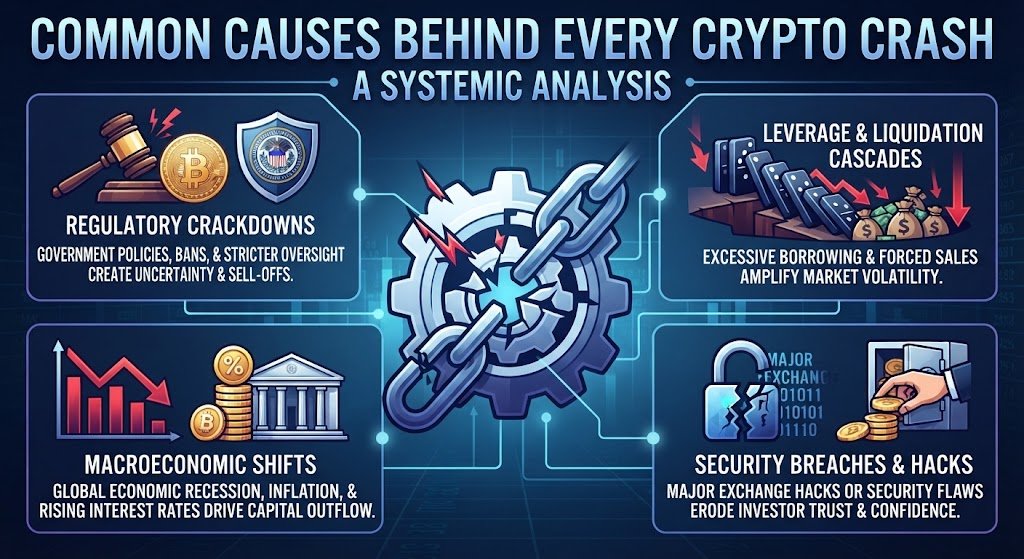
Common Causes Behind Every Crypto Crash
Understanding the root causes of a crash helps investors anticipate risk rather than simply react to it. Most crashes result from a combination of factors rather than a single event.
Regulatory Crackdowns
Government action is one of the most powerful forces in crypto markets. When regulators announce bans, restrictions, or investigations into exchanges and token issuers, uncertainty spreads quickly. Investors often sell first and ask questions later, creating a domino effect across the entire market. Countries tightening rules around crypto trading, taxation, or stablecoins have historically triggered sharp sell-offs.
Macroeconomic Pressure
Cryptocurrency does not exist in isolation from the broader economy. Rising interest rates, inflation concerns, and tightening monetary policy from central banks reduce the appetite for risky assets. When borrowing becomes expensive and safer investments like bonds offer better returns, capital tends to flow out of speculative markets, including crypto.
Leverage and Liquidations
Many crypto traders use leverage, borrowing funds to amplify their position size. While this can multiply gains, it also multiplies losses. When prices drop past a certain threshold, exchanges automatically liquidate these leveraged positions, forcing additional selling into an already falling market. This creates a liquidation cascade, where one round of forced selling triggers the next, accelerating the crash.
Exchange or Platform Failures
Collapses of major exchanges or lending platforms have historically caused some of the worst crashes in crypto history. When a large platform becomes insolvent or is accused of fraud, it shakes confidence across the entire industry, not just users of that specific platform.
Market Sentiment and Panic Selling
Crypto markets are heavily influenced by sentiment, social media chatter, and herd behavior. Fear spreads fast online, and a wave of negative headlines can push even fundamentally sound projects into a downward spiral as investors rush to exit before prices fall further.
Historical Crypto Crashes at a Glance
Looking at past crashes provides useful context for understanding market cycles.
| Period | Approximate Decline | Primary Trigger |
|---|---|---|
| Late 2017 – Early 2018 | Over 80% | End of speculative ICO boom, regulatory concerns |
| March 2020 | Around 50% in days | Global pandemic panic across all asset classes |
| May 2021 | Roughly 50% | Leverage unwinding, mining and regulatory concerns |
| 2022 | Over 70% from peak | Major lending platform and exchange collapses, rising interest rates |
While each crash had different triggers, a common pattern emerges: excessive speculation followed by a shock event that forces a rapid repricing of risk.
How a Crypto Crash Affects Investors
The impact of a crash varies depending on how an investor is positioned in the market.
- Long-term holders may see the value of their portfolio drop significantly on paper, but they are not forced to sell unless they need liquidity.
- Leveraged traders face the highest risk, as crashes can wipe out their entire position through liquidation, sometimes within minutes.
- New investors who entered near market peaks often experience the most emotional stress, as their initial investment may show steep unrealized losses.
- Businesses built around crypto, including exchanges, miners, and service providers, can see revenue drop sharply as trading volume and transaction activity decline.
Beyond financial losses, crashes also affect market psychology. Prolonged downturns can lead to reduced trading activity, fewer new projects launching, and a general cooling of enthusiasm that can last months or years before recovery begins.
Signs a Crypto Crash May Be Coming
While no one can predict market movements with certainty, several warning signs have historically appeared before major downturns.
- Excessive leverage in the system, shown by high open interest on futures markets
- Extreme greed on sentiment indicators, suggesting the market is overheated
- Rapid, unsustainable price increases disconnected from underlying adoption or use
- Rising interest rates or hawkish signals from central banks
- Negative regulatory news building up over several weeks
- Declining trading volume during price rallies, indicating weakening momentum
None of these signs guarantee a crash will occur, but a combination of several at once has historically preceded sharp corrections.
How to Protect Yourself During a Crypto Crash
While it is impossible to avoid market downturns entirely, disciplined strategies can reduce their impact on your finances.
- Avoid excessive leverage. Borrowed funds amplify losses just as much as gains, and forced liquidations during a crash can eliminate your position entirely.
- Diversify your holdings. Spreading investments across different asset classes reduces the risk of being wiped out by a single sector’s collapse.
- Only invest what you can afford to lose. Crypto remains a volatile asset class, and money needed for essential expenses should not be exposed to this level of risk.
- Set a clear investment strategy in advance. Decide your entry points, exit points, and risk tolerance before emotions take over during a downturn.
- Use dollar-cost averaging. Investing a fixed amount at regular intervals, rather than a lump sum, reduces the risk of buying at a market peak.
- Keep funds in secure storage. Using reputable wallets and exchanges reduces the risk of losing assets due to platform failure during periods of market stress.
- Avoid checking prices obsessively. Constant monitoring during a crash often leads to impulsive, emotion-driven decisions rather than rational ones.
- Keep an emergency reserve outside crypto. Having accessible savings in a stable currency means you are never forced to sell your holdings at a loss simply to cover unexpected expenses during a downturn.
- Review your portfolio periodically, not constantly. A monthly or quarterly review is usually enough to rebalance a strategy without falling into the trap of reactive, day-to-day decision-making driven by short-term price swings.
The Psychology Behind a Crypto Crash
Price charts only tell half the story. Behind every steep decline is a wave of collective human behavior that amplifies the movement far beyond what fundamentals alone would justify.
Behavioral finance experts have long studied how loss aversion drives investor decisions. People tend to feel the pain of losing money more intensely than the pleasure of gaining an equivalent amount. During a crash, this imbalance pushes many investors to sell simply to stop the emotional discomfort of watching their portfolio shrink, even when selling locks in losses that might otherwise have been temporary.
Social media plays an outsized role in crypto markets compared to traditional finance. Because crypto communities are highly active online, fear can spread within minutes rather than days. A single viral post about an exchange freezing withdrawals or a major holder dumping tokens can trigger a chain reaction of selling before the underlying story is even confirmed.
Herd mentality compounds the problem. When investors see prices falling and headlines turning negative, many assume others know something they do not, so they sell to avoid being the last one out. This self-reinforcing cycle can turn a moderate correction into a full-blown crash within hours, independent of any change in a project’s actual technology or adoption.
Recognizing these psychological patterns does not eliminate them, but it can help investors pause before making irreversible decisions. Asking whether a decision is based on new information or simply on fear watching a chart can be a useful gut check during periods of extreme volatility.
Crypto Crash vs Market Correction: What’s the Difference?
These terms are often used interchangeably, but they describe different severities of price movement.
A market correction typically refers to a decline of 10% to 20% from recent highs. Corrections are considered a normal, healthy part of any market cycle, allowing overextended prices to reset before the next phase of growth.
A crypto crash, on the other hand, involves a much sharper decline, often 30% or more, occurring rapidly and usually accompanied by panic, forced liquidations, and negative headlines dominating the news cycle. While corrections are common and expected, crashes are less frequent but far more damaging to investor confidence and short-term portfolio value.
Should You Buy During a Crypto Crash?
This is one of the most debated questions among investors, and there is no universal answer. Some investors view crashes as buying opportunities, following the principle of purchasing quality assets when prices are undervalued due to panic rather than fundamentals. Historically, disciplined investors who accumulated assets during previous downturns have benefited once markets recovered.
However, this approach carries real risk. Prices can continue falling further than expected, and there is no guarantee that any specific asset will recover its previous value. Investors considering buying during a crash should focus on projects with strong fundamentals, real-world utility, and sustainable use cases rather than speculative tokens that may not survive a prolonged downturn.
Financial decisions during volatile periods should always be based on individual risk tolerance, financial goals, and time horizon rather than short-term emotion or social media hype.
Lessons From Past Crypto Crashes
Every major downturn leaves behind lessons that shape how the market matures over time. After the speculative boom and collapse of 2017-2018, many low-quality projects with no real product disappeared entirely, while stronger networks used the downturn to keep building and eventually re-emerged with improved technology.
The 2022 collapses of several high-profile lending platforms and exchanges highlighted the danger of centralized custody, where users do not fully control their own assets. This pushed many investors toward self-custody wallets and greater scrutiny of where they store their funds, rather than blindly trusting a platform’s promised returns.
Each cycle also tends to bring incremental improvements in regulation and infrastructure. Exchanges have generally adopted stronger risk controls, and regulators in several jurisdictions have introduced clearer frameworks for stablecoins and custody requirements. While this does not eliminate future volatility, it does suggest that the market infrastructure surrounding crypto assets has gradually become more resilient after each major shock.
For everyday investors, the recurring lesson is consistent: projects with genuine utility, transparent teams, and sustainable economics tend to survive downturns, while those built purely on hype and unsustainable yield promises rarely do.
Frequently Asked Questions
What causes a crypto crash?
A crypto crash is usually caused by a combination of factors, including regulatory announcements, macroeconomic pressure, forced liquidations from leveraged trading, exchange failures, and panic-driven selling triggered by negative sentiment.
How long does a crypto crash usually last?
The duration varies significantly. Some crashes recover within weeks, while others have led to extended bear markets lasting a year or more before prices stabilize and begin trending upward again.
Is it safe to invest in crypto after a crash?
Investing after a crash carries both opportunity and risk. While prices may be undervalued, there is no guarantee of recovery, so investors should research fundamentals carefully rather than assuming a rebound is inevitable.
How can I tell the difference between a correction and a full crash?
A correction is generally a decline of 10% to 20% considered normal in any market cycle, while a crash involves a much steeper and faster decline, often exceeding 30%, accompanied by panic selling and forced liquidations.
Do all cryptocurrencies crash at the same time?
Not necessarily, but major crashes tend to affect the broader market since Bitcoin and Ethereum often set the overall sentiment. Altcoins typically experience even sharper declines than larger, more established coins during a crash.
Can leverage make a crypto crash worse?
Yes. High leverage in the market increases the risk of liquidation cascades, where forced selling from one group of traders pushes prices down further, triggering additional liquidations in a chain reaction.
What should I avoid doing during a crypto crash?
Avoid panic selling without a plan, taking on additional leverage to “average down,” and making major financial decisions based purely on fear or social media sentiment rather than research and a predefined strategy.
When did crypto crash?
Crypto has crashed multiple times throughout its history rather than just once. Notable downturns occurred in late 2017 into early 2018 after the ICO boom faded, in March 2020 during the initial pandemic panic, in mid-2021 following a wave of leveraged liquidations, and throughout 2022 after several major lending platforms and exchanges collapsed. Each of these periods saw major assets lose 50% or more of their value within a matter of weeks or months.
What is the history of crypto crashes?
Crypto crash history follows a repeating pattern of rapid growth followed by sharp correction. Early crashes were driven largely by speculative bubbles and thin liquidity, while more recent downturns have involved macroeconomic pressure, rising interest rates, and failures of centralized platforms holding customer funds. Studying this history shows that while triggers vary, excessive leverage and overheated sentiment are almost always present before a major decline, and markets have historically recovered over subsequent cycles, though recovery timelines are never guaranteed.
Can a crypto crash be predicted?
No indicator can reliably predict the exact timing or severity of a crypto crash. Analysts do track warning signs such as elevated leverage, extreme sentiment readings, and slowing trading volume during price rallies, which have historically preceded downturns. However, these signals only indicate elevated risk, not a certainty, and unexpected events like regulatory announcements or platform failures can trigger a crash with little advance warning. Predictions about crypto crashes should be treated as risk indicators rather than precise forecasts.
Why is crypto crashing and will it recover?
A crypto crash is usually driven by a mix of forced liquidations, negative sentiment, and broader economic pressure rather than a single cause. Whether the market recovers depends on the underlying reason for the decline: crashes tied to short-term panic or excess leverage have historically been followed by recovery once weak positions are cleared out, while prolonged downturns tied to structural issues, such as widespread platform insolvency, can take longer to stabilize. Past cycles have shown that major assets like Bitcoin and Ethereum have recovered from previous crashes over time, though past performance does not guarantee future results, and full recovery is never guaranteed.
Conclusion
A crypto crash can feel overwhelming, but understanding its causes and patterns helps investors respond with strategy rather than panic. From regulatory shifts and macroeconomic pressure to leverage-driven liquidation cascades, most crashes share common warning signs that disciplined investors can learn to recognize. By diversifying holdings, avoiding excessive leverage, and maintaining a clear long-term strategy, you can reduce the emotional and financial impact of the next downturn. Markets are cyclical by nature, and while a crypto crash tests investor patience, informed decision-making remains the most reliable tool for navigating volatility.
