

The Iran Israel war technology deployed since June 2025 has turned the Middle East into the most closely watched weapons laboratory on the planet. From stealth jets slipping past radar to laser cannons burning drones out of the sky, this conflict has shown the world exactly how modern militaries fight — and what it costs.
What makes this war different is the sheer variety of systems in play. This article breaks down the Iran Israel war technology on both sides, the specific machinery Israel used, whether any sanctions apply to Israeli arms, and the intelligence tools that finally pinpointed Iran’s Supreme Leader. If you’ve been trying to make sense of the headlines, this guide puts it all in one place.
Background: Why Did the Iran-Israel War Start?
The roots of this conflict go back well before the first missile was fired. Israeli military intelligence reported in January 2025 that Iran’s nuclear “weapon group” — a team of scientists working on the technical steps needed to build a functioning bomb — had been reassembled and was making faster progress than expected. By the time the June 2025 war began, Iran was reportedly enriching uranium to 60% purity, edging closer to the roughly 90% threshold needed for weapons-grade material.
That timeline shortened Israel’s window to act. Officials had reportedly decided as early as late 2024 that Iran needed to be struck militarily before it could cross the nuclear threshold, with a target window set for no later than the first half of 2025. Iran, for its part, had already shown its willingness to strike Israeli territory directly — most notably in the October 2024 missile barrage that hit military facilities including Nevatim and Tel Nof airbases and caused damage in several Israeli towns. Iran’s Supreme Leader Ali Khamenei consistently denied that the country was pursuing a weapon on religious grounds, but Israeli and American officials treated the capability itself, regardless of stated intent, as the trigger for military action.
A New Kind of War: Missiles, Drones, and Lasers Together
Military analysts have started calling this the “Second Drone War” — a follow-up to the drone-heavy Russia-Ukraine conflict, but with far more ballistic missiles and, for the first time in real combat, directed-energy weapons firing every day. The 12-day war of June 2025, codenamed Operation Rising Lion by Israel, set the template: over 200 Israeli aircraft flew strike missions, dropping more than 330 munitions on roughly 100 targets across Iran. Iran answered with waves of ballistic missiles and swarms of low-cost drones aimed at Israeli cities and infrastructure.
That first round ended in a ceasefire, but it didn’t end the story. Fighting flared again in early 2026, culminating in a strike that killed Iran’s Supreme Leader Ali Khamenei in February 2026 — an event that reshaped the entire conflict and put Israeli and American intelligence technology under a global spotlight.
What’s striking is how different this war looks from earlier Middle East conflicts. Instead of ground invasions and long troop columns, this has been fought almost entirely in the air, at sea, in cyberspace, and through intelligence networks. Rafael’s chairman Yuval Steinitz summed it up plainly: the war was carried out through long-range ballistic missiles, precision air-to-ground munitions, cyberattacks, drones, and autonomous systems, not old-style mechanized warfare. That shift matters, because it means the technology gap between the two sides — rather than the size of their standing armies — has been the deciding factor at almost every stage.
What Military Technology Did Israel Use in the Iran War?
Israel’s campaign leaned on two decades of investment in precision-strike aircraft and layered air defense. The country’s own defense industry — led by Israel Aerospace Industries, Rafael, and Elbit Systems — supplied most of the hardware, with the United States filling in critical gaps like heavy bunker-busting bombs.
Israeli F-35 stealth fighters formed the backbone of the air campaign, crossing into Iranian airspace largely undetected thanks to their low radar signature. Alongside them, F-15 squadrons carried out long-range strikes, dropping precision-guided munitions developed specifically to hit hardened targets from a distance while evading Iranian electronic warfare.
°
Default
| System | Type | Primary Role |
|---|---|---|
| F-35I Adir | Stealth fighter jet | Deep-strike missions, air superiority |
| F-15I Ra’am | Strike fighter | Long-range precision bombing |
| Arrow 3 | Exo-atmospheric interceptor | Shooting down ballistic missiles outside the atmosphere |
| David’s Sling | Mid-range interceptor | Countering medium-range missiles and rockets |
| Iron Dome | Short-range interceptor | Intercepting rockets and short-range threats |
| Iron Beam | Laser weapon | Burning down drones and rockets at low cost per shot |
Israel military technology also included pre-positioned assets inside Iran itself. Reports describe covert drone units smuggled into the country months in advance, stored in modified civilian vehicles and warehouses near Tehran, then activated remotely once the campaign began — a tactic that let Israel strike from inside Iranian territory without a single aircraft crossing the border for those specific hits.
This inside-out approach is arguably what separated Israel’s campaign from a conventional bombing run. Within 48 hours of the opening strikes, the Israeli Air Force claimed it had achieved aerial superiority over Tehran itself — a claim backed by the fact that Iranian air defenses struggled to track aircraft they couldn’t see coming and drones they didn’t know were already inside the country. Combine that with precision munitions capable of hitting targets accurately even under electronic jamming, and Israel effectively removed Iran’s ability to contest its own airspace within days rather than weeks.
What Weapons and Technology Did Iran Use Against Israel?
Iran’s approach has always been built around mass rather than precision — firing large numbers of comparatively low-cost missiles and drones to overwhelm Israeli air defense, which is expensive to operate and limited in interceptor supply.
Iran’s ballistic missile arsenal ranges from short-range systems it can fire quickly in volleys to medium-range weapons capable of striking anywhere in Israel.
| Missile/Drone | Range | Notes |
|---|---|---|
| Shahed-136 / Shahed-131 | Loitering munition (drone) | Cheap, slow-flying decoys used in mass “swarm” attacks |
| Shahab-3 | ~2,000 km ballistic missile | Core medium-range strike weapon |
| Emad | Medium-range ballistic missile | Improved accuracy over older Shahab variants |
| Ghadr-1 | Medium-range ballistic missile | Extended-range strike capability |
| Sejjil | Medium-range, solid-fuel missile | Faster launch preparation than liquid-fuel missiles |
| Fateh / Zolfaghar / Qiam-1 | Short-range ballistic missile | Rapid volley-fire, compresses warning time |
Iran also struck Israeli research and industrial sites directly. On June 15, 2025, Iranian ballistic missiles hit the Weizmann Institute of Science in Rehovot, damaging roughly 90% of the campus structures and suspending about a quarter of its operations, with no reported casualties. This showed that despite Israel’s layered defenses, some Iranian missiles were still getting through.
Iran’s own military leadership has framed the fight in bigger terms than a two-country conflict. Army chief Major General Amir Hatami said publicly that Iran’s forces weren’t just fighting Israel, but effectively “the core of technology provided by Western and NATO countries” to Israel — a reference to how much of Israel’s precision-strike capability depends on American components, intelligence sharing, and funding. Whether or not one agrees with that framing, it points to a real pattern: much of this war has been a test of supply chains and alliances as much as individual weapons.
Which Directed-Energy and Laser Weapons Were Used in the War?
This conflict is the first real-world proving ground for laser weapons fired in sustained, day-to-day combat. On the American-Israeli side, the U.S. military’s HELIOS and ODIN laser systems worked alongside Israel’s home-grown Iron Beam to shoot down Iranian attack drones. Rafael’s leadership has described the laser program as a genuine “historic breakthrough” — a capability that superpowers had chased for years, brought to an actual battlefield for the first time.
The appeal is cost. A laser shot costs a fraction of a missile interceptor, which matters enormously when the other side is firing dozens of cheap drones just to drain your interceptor stockpile. Alongside lasers, both sides leaned on cyberattacks, unmanned systems, and autonomous platforms — Rafael’s own chairman described the war as fought primarily through “long-range ballistic missiles, precision air-to-ground munitions, cyberattacks, UAVs, and other autonomous systems,” rather than old-fashioned troop movements.
How Did the United States Support Israel’s Military Campaign?
Washington’s role went well beyond diplomatic backing. American forces supplied naval and air defense assets, including the ship-based Aegis Combat System and Patriot and THAAD batteries, layered alongside Israel’s own defenses to intercept incoming Iranian ballistic threats. The U.S. also fielded the 30,000-pound “bunker buster” bomb — a weapon specifically designed to reach deeply buried targets like underground nuclear facilities, something no other country in the coalition could deliver.
American intelligence agencies, particularly the CIA, also played a direct role in the targeting process that would eventually locate Khamenei, combining satellite imagery, signals intercepts, and human sources gathered over months, then sharing that picture with Israeli intelligence.
Are There Sanctions or Restrictions on Israeli Military Technology?
Yes — but the picture is mixed, and restrictions have had limited practical effect on Israel’s ability to fight. Several countries introduced arms embargoes or export restrictions on Israel in response to the war in Gaza, separate from the Iran conflict itself.
| Country/Bloc | Measure | Status |
|---|---|---|
| Spain | Full legal ban on defense exports to and imports from Israel | In force since late 2025 |
| United Kingdom | Partial suspension of arms export licenses (30 of ~350) | Partial, ongoing |
| Germany | Temporary embargo on exports to Israel | Lifted in 2026 |
| Belgium | Restrictions on specific military exports | In force since 2024 |
| Philippines | Cancelled defense contracts with Israeli firms | Cancelled in 2025-2026 |
Despite these measures, Israel’s own arms exports — the technology it sells to other countries — hit a record $19.2 billion in 2025, up nearly 30% from the previous year. Germany alone signed a $3.1 billion deal for Arrow 3 missile systems, and government-to-government sales made up more than half of all Israeli exports that year. In other words, sanctions have targeted what flows into Israel far more than what Israel sells out, and even the import-side restrictions haven’t stopped the country’s core weapons programs, most of which are domestically produced.
Germany’s case is a useful example of how inconsistent these restrictions have been in practice. Berlin briefly halted its own exports to Israel, but Chancellor Friedrich Merz lifted that embargo ahead of a visit to Israel, and officials were careful to clarify the restriction only ever applied to German weapons flowing to Israel — never to Israeli weapons flowing into Germany. With Germany’s defense budget climbing past $100 billion and expected to grow by another $10 billion by 2026, Israeli firms have found a rapidly expanding customer rather than a closed door.
Which Countries Are Buying Israeli Military Technology Despite the War?
Interest in Israeli-made defense systems has spread well beyond its traditional buyers. Surveillance systems and optoelectronics alone made up 22% of Israeli exports in 2025, up sharply from just 6% the year before, while manned aircraft and avionics, radar and electronic-warfare systems, and command-and-control technology each contributed double-digit shares. Sales to the Asia-Pacific region nearly doubled year over year, and Abraham Accords partner nations have also expanded their purchases of Israeli equipment. A senior Israeli defense official told Reuters that European countries were expected to keep ordering more air and missile defense systems, precisely because they now see Israeli-tested technology as combat-proven in a way few competitors can claim.
That combat-tested reputation is really the core of the sanctions paradox. A government that wants to publicly support restrictions on Israel also has to weigh the fact that pulling back from Israeli air-defense technology could weaken its own military readiness — especially for smaller countries that lack the budget to develop equivalent systems domestically. That tension is a big part of why so many embargoes have stayed partial, temporary, or focused narrowly on politically sensitive categories rather than blocking Israeli technology outright.
Did Sanctions Actually Slow Down Israel’s Arms Exports?
Not meaningfully, at least not yet. The data tells a fairly blunt story: public criticism and formal embargoes from some governments have coexisted with record procurement from those same governments’ defense ministries.
| Year | Israeli Defense Exports | Change |
|---|---|---|
| 2022 | ~$12.5 billion | — |
| 2023 | ~$13.6 billion | +9% |
| 2024 | ~$14.8 billion | +9% |
| 2025 | ~$19.2 billion | +30% |
Analysts point to a simple reason: many of the countries publicly debating sanctions rely on Israeli-made air defense systems like Iron Dome components, Barak MX, and Arrow 3, or on Israeli surveillance and electronic-warfare technology, for their own security. Cutting that supply chain would mean weakening their own defenses — a trade-off few governments have been willing to make in practice, even while restricting what they sell to Israel.
What Technology Was Used to Track and Target Khamenei?
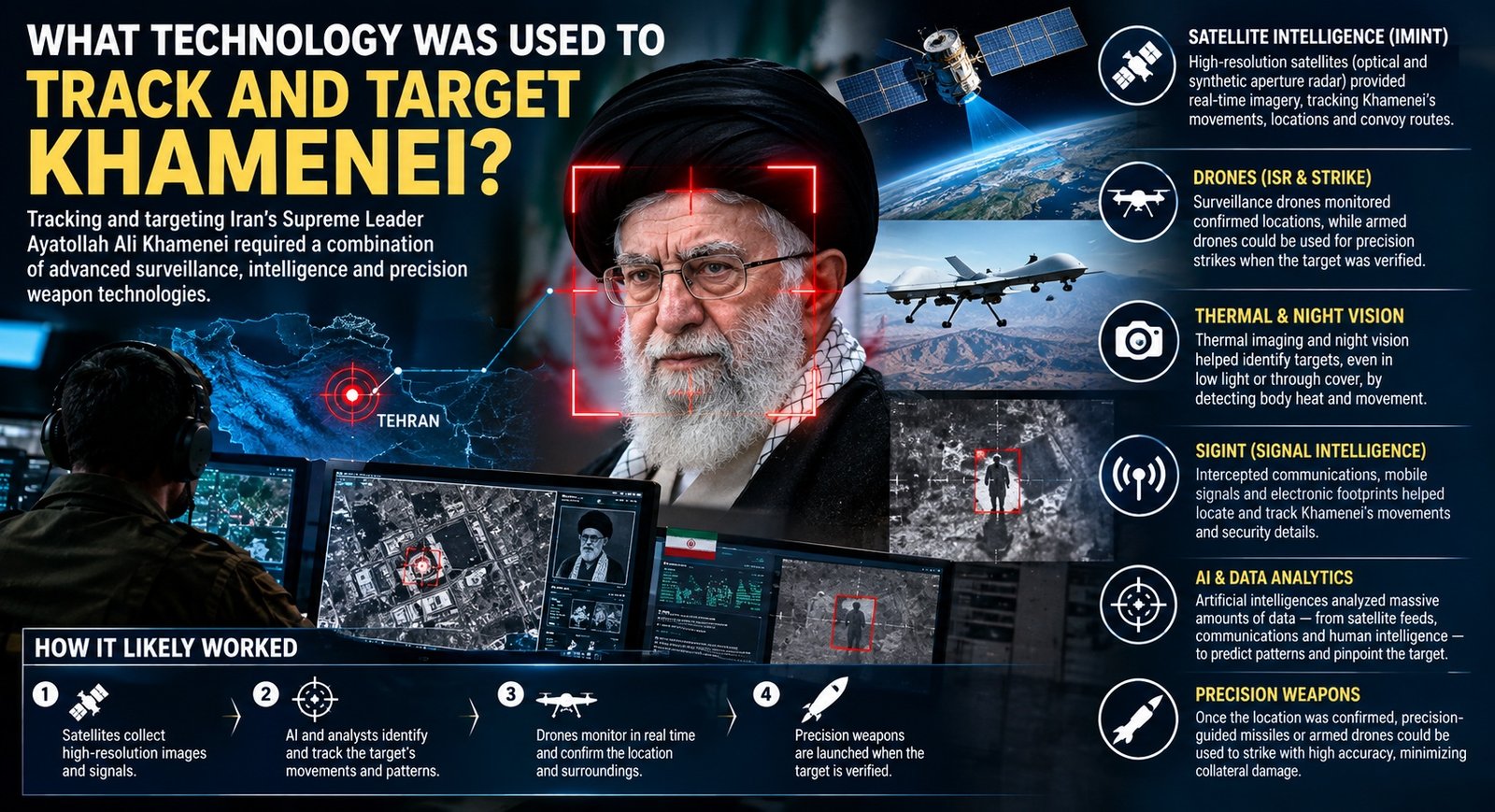
This is the part of the story that changed the war’s direction. During the initial 12-day war in June 2025, Israel made no confirmed attempt to strike Khamenei directly — officials later said he had gone into a deep bunker, one so far underground that its elevator reportedly took over five minutes to reach it, making him effectively untouchable in the moment.
That changed by February 2026. According to multiple news investigations, a combination of intelligence-gathering methods built the picture that finally located him:
- Signals intelligence (SIGINT) from Israel’s Unit 8200, intercepting communications around Khamenei’s inner circle.
- Human intelligence (HUMINT) from long-recruited Mossad assets inside Iran, tracking mundane details like food deliveries and daily movement patterns over years.
- Satellite imagery used to monitor his compound and confirm activity patterns.
- Hacked Tehran traffic camera networks, reportedly used to help build a real-time picture of movement around central Tehran.
- US signals and over-the-horizon targeting support, with the CIA sharing intelligence gathered over months with Israeli counterparts.
The combined data was processed into what reports describe as a 14-digit grid coordinate — precise enough for a guided air strike. On February 28, 2026, Israeli intelligence determined Khamenei would be above ground at his official Tehran compound for a meeting with senior security officials, rather than in his bunker. The Israeli Air Force carried out what the IDF called a “precise, large-scale operation,” killing Khamenei along with several senior Iranian officials. Iranian state media reported his daughter, grandchild, daughter-in-law, and son-in-law were also among those killed in the same strikes.
The months of patience behind this operation stand out as much as the technology itself. After the June 2025 war, Khamenei reportedly became far more reclusive, retreating to a bunker so deep that reaching it by elevator took more than five minutes — which meant strike windows were rare and had to be near-perfect. Defense Minister Israel Katz later admitted Israel simply didn’t get the chance to target him during that first round because he had gone silent and underground. It took roughly seven more months of accumulated surveillance, pattern analysis, and processing power to build enough confidence in his above-ground movements to authorize a strike. Alongside Khamenei, the same operation reportedly killed Ali Shamkhani, a longtime security adviser Israel had targeted unsuccessfully back in June 2025, and Mohammad Pakpour, commander of Iran’s Revolutionary Guard, who had overseen the country’s missile and drone operations against Israel.
How Did Cyber Warfare Factor Into the Iran-Israel Conflict?
Digital attacks ran alongside every missile exchange. Both countries leaned heavily into cyberspace — Israel targeting Iranian command networks and infrastructure, Iran attempting disruptive attacks on Israeli systems. The hacked traffic camera network used to help locate Khamenei is itself a good example of how blurred the line has become between cyber operations and physical targeting: a network built for city traffic management ended up feeding one of the most consequential intelligence operations of the war.
Iran’s army chief, Major General Amir Hatami, later argued publicly that Iran had effectively been fighting the combined weight of Western and NATO technology funneled through Israel, not Israel alone, pointing to the scale of intelligence and equipment support Israel received from allied nations throughout the war. He also noted that the 12-day war, despite its short length, gave Iranian pilots direct combat experience against a technologically superior air force — lessons he said were being carefully documented for future preparedness, even as Iran’s broader military position weakened.
What Role Did Drones Play in the Iran-Israel War?
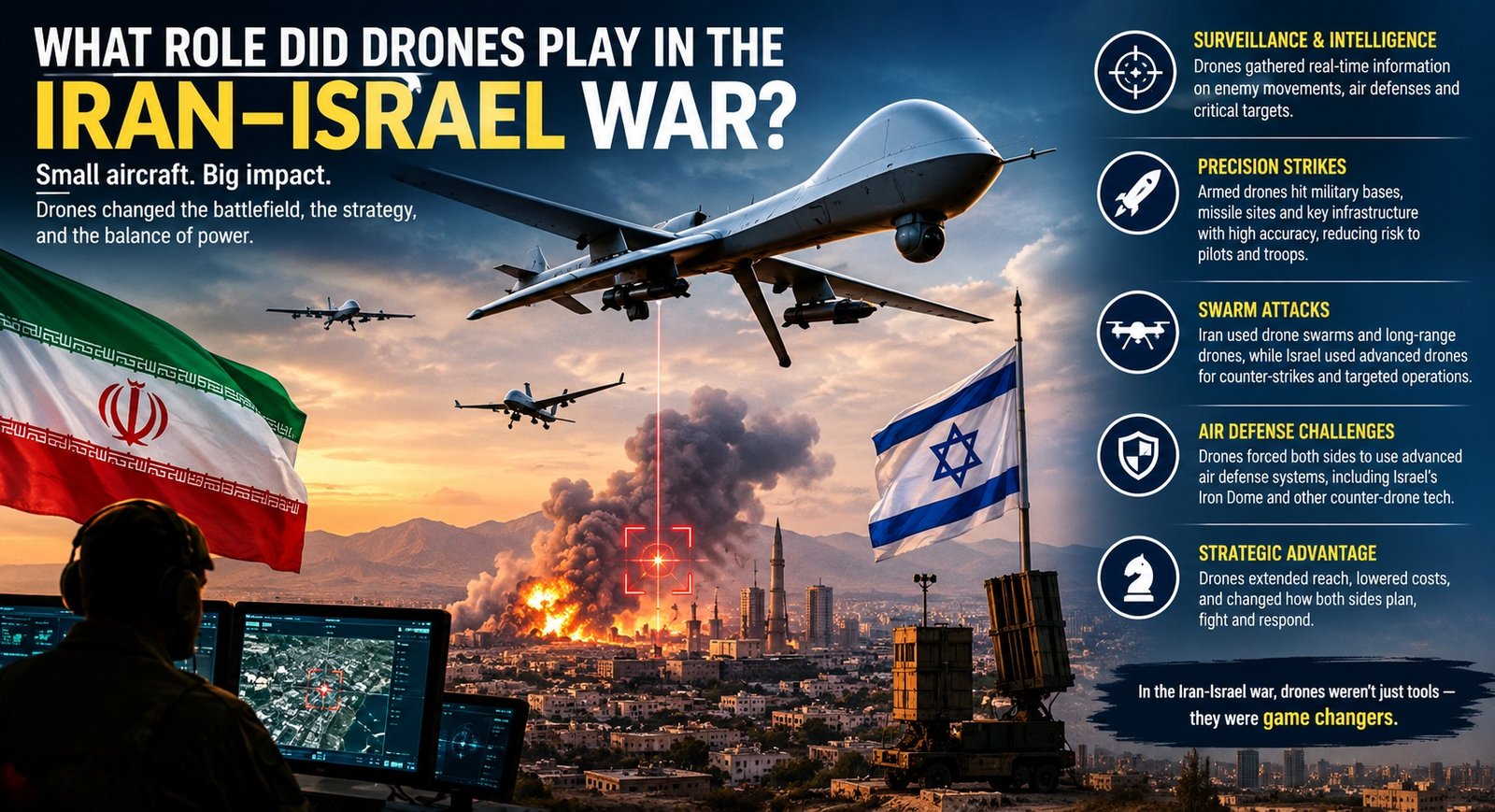
Drones defined this war’s rhythm the way tanks defined earlier ones. Iran’s Shahed-136 and Shahed-131 loitering munitions — cheap, slow, and produced in large numbers — were fired in swarms designed less to guarantee individual hits and more to exhaust expensive Israeli interceptors, forcing defenders to spend costly missiles on low-cost drones. On the Israeli side, pre-positioned covert drone units inside Iran struck missile launchers and infrastructure from within, removing the need to fly aircraft across the border for every target.
| Drone/System | Side | Purpose |
|---|---|---|
| Shahed-136 | Iran | Mass swarm attacks, saturate air defense |
| Shahed-131 | Iran | Smaller loitering munition, similar swarm role |
| Covert pre-positioned UAVs | Israel | Internal sabotage strikes on launchers/stockpiles |
| Reconnaissance UAVs | Both | Real-time surveillance and targeting support |
The economics of drone warfare explain a lot about how both sides planned their campaigns. A Shahed-136 costs a small fraction of what a single Arrow 3 or Patriot interceptor costs to fire back at it — so even when Israeli defenses intercepted the vast majority of incoming threats, as both militaries reportedly managed for most of the conflict, the cost imbalance still favored Iran’s volume approach over time. That imbalance is exactly why laser weapons like Iron Beam matter so much strategically: a laser shot costs closer to a few dollars in electricity than the hundreds of thousands of dollars a missile interceptor costs, which is the only way layered defense stays financially sustainable against endless drone swarms.
How Does This War Compare to Other Modern Conflicts?
Analysts studying this war keep coming back to one comparison: the Russia-Ukraine conflict that began in 2022, often described as the First Drone War for how it popularized cheap unmanned systems in modern combat. The Iran-Israel war has taken that same drone-centric approach and layered in far more ballistic missile traffic, deeper intelligence penetration, and now sustained laser weapon use — differences significant enough that military writers have already started calling this the Second Drone War rather than a simple repeat of the earlier conflict.
The other major difference is reach. Where the Russia-Ukraine war has stayed largely contained to a shared border region, Iran and Israel struck targets across roughly a thousand miles of hostile airspace, supported by intelligence and weapons networks spanning multiple continents. That distance is only possible because of the specific mix of stealth aircraft, satellite-guided precision munitions, and long-range missile technology both sides have invested in for decades — making this arguably the clearest real-world test yet of how far modern air power projection has come.
FAQs About Iran Israel War Technology
What is the Iran Israel war technology that defined the June 2025 conflict?
The defining Iran Israel war technology included Israeli F-35 stealth jets, layered missile defenses like Iron Dome and Arrow 3, and Iran’s Shahed drone swarms paired with ballistic missiles.
Did the US directly use its own weapons in the Iran-Israel war?
Yes. The US deployed Patriot and THAAD batteries, the Aegis Combat System, and its 30,000-pound bunker-buster bomb to support Israeli strikes on nuclear-related sites.
Are laser weapons a real part of Iran Israel war technology now?
Yes. Israel’s Iron Beam and the US HELIOS and ODIN systems have been used in actual combat to shoot down drones, marking the first sustained real-world use of laser weapons.
Is there an arms embargo on Israel because of the war?
Partial embargoes exist from Spain, the UK, and Belgium, but Israel’s own arms exports still hit a record $19.2 billion in 2025 despite this Iran Israel war technology dispute.
How was Khamenei’s location finally found in 2026?
Israeli and US intelligence combined signals intercepts, human sources, satellite imagery, and hacked traffic cameras to pinpoint his Tehran compound, a major leap in Iran Israel war technology application.
Why are drones called the defining weapon of this war?
Iran’s cheap Shahed drone swarms exhausted costly Israeli interceptors, while Israeli covert drones struck from inside Iran, making unmanned systems central to modern Iran Israel war technology.
Will sanctions eventually restrict Israeli military technology exports?
So far, restrictions have targeted imports into Israel more than its exports, and current Iran Israel war technology sales keep breaking annual records despite political pressure.
Conclusion
The Iran Israel war technology used since 2025 has reshaped how experts think about modern conflict — stealth aircraft and bunker-busting bombs on one side, mass-produced drones and volley-fired missiles on the other, and for the first time, laser weapons doing real work on both. Israel’s own Iran Israel war technology stack, built on decades of domestic investment and backed by American hardware, gave it a clear edge in precision and air defense, while Iran leaned on volume and unpredictability to keep pressure on.
Sanctions have chipped at the edges of Israel’s import pipeline without denting its booming arms exports, and the intelligence work behind locating Khamenei shows how far signals and surveillance technology have advanced since the war’s first phase. Whatever comes next in this region, the tools on display here — lasers, drone swarms, and precision intelligence — are the ones other militaries will now be studying and, in many cases, buying.
For readers trying to track where this goes next, three things are worth watching. First, whether Iran’s post-Khamenei leadership can rebuild the missile and drone stockpiles Israel spent months degrading, or whether the loss of senior IRGC commanders slows that recovery. Second, whether more governments follow Spain’s lead on a full legal arms embargo, or whether Germany’s quiet reversal becomes the more common pattern as defense budgets keep rising across Europe. Third, whether directed-energy weapons like Iron Beam move from a wartime emergency measure into a standard part of national air-defense doctrine, given how directly they address the cost problem that cheap drone swarms were designed to exploit. However this Iran Israel war technology story develops from here, the pattern it has already set — precision over mass, intelligence over manpower, and cost-per-shot as a real strategic variable — looks likely to shape how the next major conflict, wherever it happens, gets fought.
