

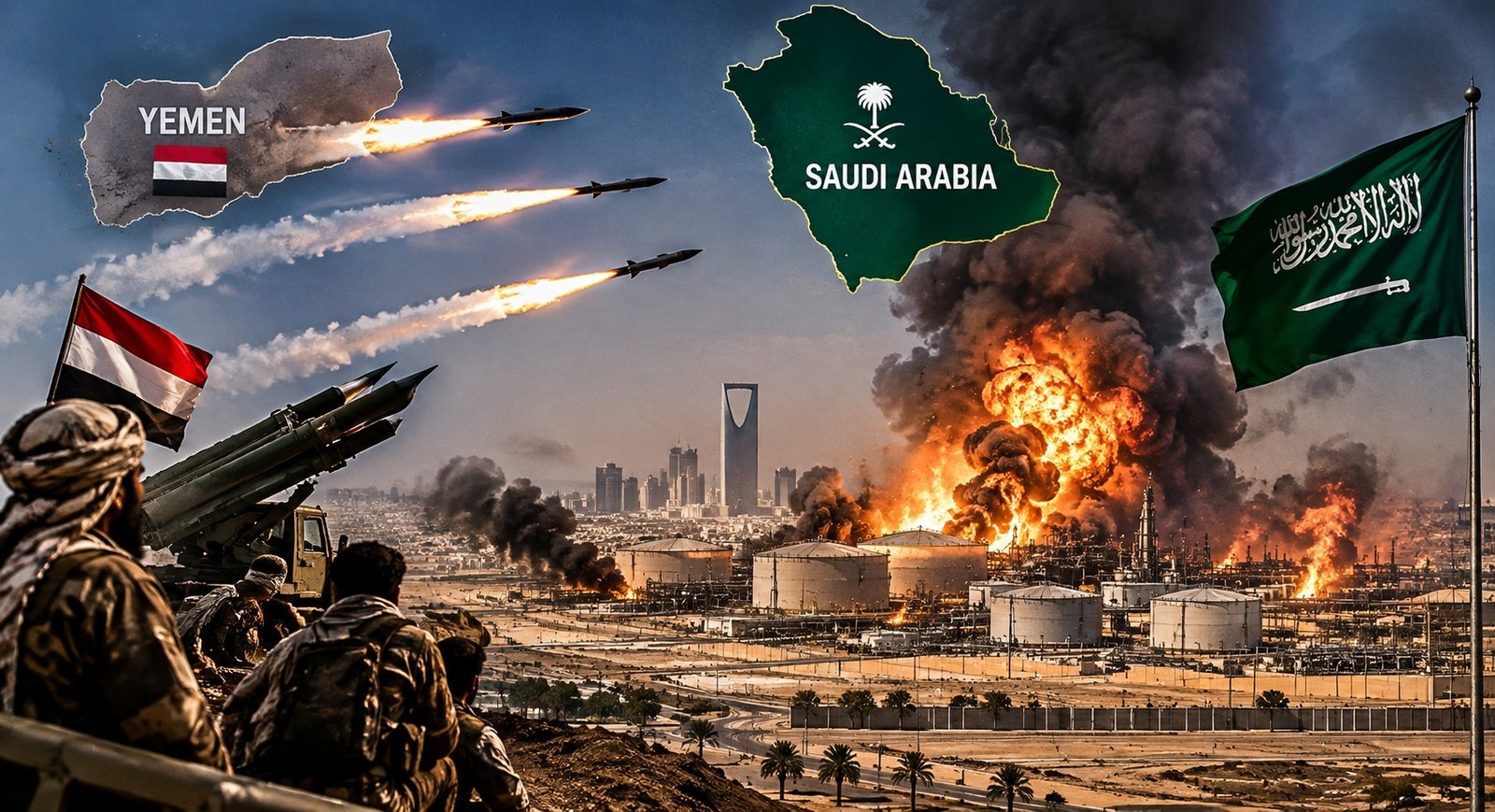
The latest Yemen attack on Saudi Arabia has pushed a conflict most of the world thought was winding down back into the headlines. On September 8, 2026, Iran-backed Houthi forces launched one of their largest strikes on the Kingdom in years, hitting oil facilities, an air base, and civilian areas across four cities — and reopening a debate about whether Pakistan is now obligated to respond under its new defense pact with Saudi Arabia.
This guide breaks down exactly what happened, how much damage the Yemen attack on Saudi Arabia actually caused, what the Houthis themselves are saying about it, and whether the Mecca Joint Defence Agreement genuinely commits Pakistan to warn or strike Yemen. If you’ve been trying to piece the story together from scattered headlines, this covers it all in one place.
What Happened in the Latest Houthi Attack on Saudi Arabia?
Early on Tuesday, September 8, 2026, Houthi forces fired a wave of ballistic missiles and drones at four cities in southern and southwestern Saudi Arabia: Abha, Khamis Mushait, Jazan, and Najran. According to Saudi-led coalition spokesman Maj. Gen. Turki al-Maliki, the strikes hit “civilian and economic sites” and wounded at least 73 people, including women and children. A Yemeni security official told The National that at least one ballistic missile and one drone were launched from Saada in northern Yemen the night before, with further attacks following Tuesday morning.
This wasn’t an isolated incident. It came after weeks of intensifying clashes that had already shattered a fragile truce which had held since 2022, following renewed fighting between the Houthis and Saudi-backed, internationally recognized Yemeni government forces around Taiz, Hodeidah, and the strategically important Bab al-Mandeb corridor. More than 300 people had reportedly been killed or wounded in the ground fighting alone in the days leading up to the September 8 escalation.
To put this in context: Yemen’s civil war stretches back to 2014, when Houthi forces seized the capital, Sanaa, prompting a Saudi-led coalition to intervene militarily in 2015 to try to restore the internationally recognized government. That war ground on for years, periodically boiling over into direct Houthi strikes on Saudi territory — oil facilities, airports, and border areas have all been hit at various points over the past decade. A relative calm held from 2022 onward under a UN-backed truce, but the collapse of that truce in July 2026 reopened active fighting on the ground, with government forces launching counteroffensives aimed at retaking territory and the Houthis pushing to expand their control toward the Red Sea coast. The September 8 strikes on Saudi Arabia are best understood as the cross-border spillover of that renewed ground war, not a standalone event.
What Damage Did Saudi Arabia Suffer From the Yemen Attack?
The physical damage was concentrated in Saudi Arabia’s energy and southern military infrastructure. Houthi military spokesman Brig. Gen. Yahya Saree said in a prerecorded video statement that the group had fired “dozens of ballistic missiles and drones” at oil and economic facilities as well as an air base in the south of the kingdom.
| Target | Location | Reported Impact |
|---|---|---|
| Jazan City for Primary and Downstream Industries | Jazan | Major industrial/logistics hub targeted; fires reported |
| Aramco facilities | Najran, Abha | Fires ignited at oil and utility facilities |
| Jazan oil refinery (400,000 bpd capacity) | Jazan | One of Saudi Arabia’s largest refineries, in the targeted region |
| King Khalid Air Base | Khamis Mushait | Military airbase reported among targeted sites |
| Civilian areas | Abha, Khamis Mushait, Jazan, Najran | 73 civilians wounded, including women and children |
The Saudi Energy Ministry confirmed fires broke out at several facilities in the southern region, temporarily halting some operations, though officials did not report any deaths from the September 8 strikes specifically. The attacks also had an immediate market effect: oil prices rose more than 1% afterward, with traders worried that Saudi crude exports routed through the Red Sea — now a critical alternative to the Strait of Hormuz, which has been constrained by the broader Iran conflict — could be put at further risk. Between March and mid-July 2026, Saudi seaborne crude exports through Bab al-Mandeb were reportedly eight times higher than during the same period in 2025, which shows how much weight that route is now carrying.
This is not the first time Houthi forces have targeted Saudi energy infrastructure this year. In August 2026, the group claimed attacks on oil installations in Yanbu, Saudi Arabia’s principal west-coast export gateway, and Aramco’s chief executive Amin Nasser said at the time that the attacks had caused some production interruptions but no material operational or financial impact once operations were restored. The Houthis also declared a blockade on Saudi Arabia in the Red Sea the same month, threatening shipping through the Bab al-Mandeb Strait — a threat that has only grown more consequential given how much more Saudi oil is now moving through that exact route.
Why Did the Houthis Attack Saudi Arabia? What Does Yemen Say?
According to the Houthi military’s own statement, the September 8 strikes were retaliation. The group said they were responding to what it described as more than 100 Saudi airstrikes across Yemen over the preceding three days, which it claimed had killed a significant number of people. The attacks also came hours after the Houthis blamed Saudi Arabia for an airstrike that hit a prison in Yemen’s northern al-Jawf province, which they said killed at least seven people, including a child.
Nasruddin Amer, deputy head of the Houthi media office that runs the Houthi-controlled Saba news agency, was blunt in his framing of the strikes on social media: he said Saudi Arabia had to understand that “the time for committing crimes and massacres against the Yemeni people without response, deterrence or paying a price has ended.” Saree, the Houthi military spokesman, placed the blame squarely on Saudi Arabia for the overall escalation, and warned of further retaliation if the strikes on Yemen continued.
In short, Yemen’s Houthi movement frames this as a direct, proportional response to Saudi-led airstrikes inside Yemen, not an unprovoked attack — a narrative Saudi officials firmly reject.
How Has Saudi Arabia Responded to the Attacks?
Saudi officials have described the strikes as a “dangerous escalation” and promised a firm response. Al-Maliki said the Saudi-led coalition would take “all necessary operational measures to deter the terrorist Houthi militia with utmost resolve.” Saudi Arabia’s Foreign Minister, Prince Faisal bin Farhan, speaking while in Moscow, called the attacks part of “a series of provocations” by the Houthis and accused the group of prioritizing its own narrow interests over those of the Yemeni people, despite what he described as a Saudi offer to negotiate peace. He added that the kingdom “will not hesitate to defend ourselves.”
The Saudi Foreign Ministry separately stated on social media that “the kingdom affirms its legitimate right to take all necessary measures to defend its sovereignty.”
What Is the Mecca Joint Defence Agreement Between Pakistan, Saudi Arabia and Turkey?
To understand whether Pakistan can legally warn or strike Yemen, you first need to understand what the Mecca pact actually says. The Mecca Joint Defence Agreement — formally the Makkah Defence Alliance — was signed on August 7, 2026, in Mecca by Saudi Crown Prince Mohammed bin Salman, Turkish President Recep Tayyip Erdoğan, and Pakistani Prime Minister Shehbaz Sharif. It builds on an earlier bilateral deal, the Strategic Mutual Defence Agreement (SMDA), which Pakistan and Saudi Arabia signed on September 17, 2025, at Al-Yamamah Palace in Riyadh — itself a response to an Israeli strike on Qatar the same month, the first attack of its kind against a Gulf state.
| Feature | Detail |
|---|---|
| Signed | August 7, 2026, in Mecca, Saudi Arabia |
| Parties | Pakistan, Saudi Arabia, Turkey |
| Core clause | “Any armed attack against any one of the three states shall be regarded as an attack against them all” |
| Modeled on | Article 5 of the NATO charter |
| Builds on | 2025 Pakistan-Saudi Strategic Mutual Defence Agreement |
| Stated scope | Officially “purely defensive,” not aimed at any named country |
| Role division | Saudi Arabia funds projects, Turkey provides deep-tech defense equipment, Pakistan provides frontline manpower |
The agreement’s headline clause is modeled on NATO’s mutual-defense principle: an attack on one signatory is treated as an attack on all three. Pakistani Foreign Minister Ishaq Dar publicly described the pact as “purely defensive in nature” and said it remained open to other countries willing to uphold its principles and resolve disputes peacefully. Officials from all three countries have repeatedly stressed that the agreement names no specific adversary and is not directed at Iran or any other state.
Each of the three partners brings something different to the table, which is part of why analysts describe this as a genuinely new kind of arrangement rather than a simple copy of a Western alliance. Pakistan is the only nuclear-armed country in the Muslim world and brings extensive combat and manpower experience; Saudi Arabia brings substantial financial resources and regional political weight; Turkey, a NATO member, brings a large standing military and an increasingly capable domestic defense industry. Council on Foreign Relations analyst Steven A. Cook has described the pact as a “major change” in Middle East geopolitics and the first institutional arrangement of its kind in the region, reflecting a broader shift in which Gulf states are building security guarantees outside the traditional US-led framework.
Can Pakistan Warn or Attack Yemen Under the Mecca Pact?
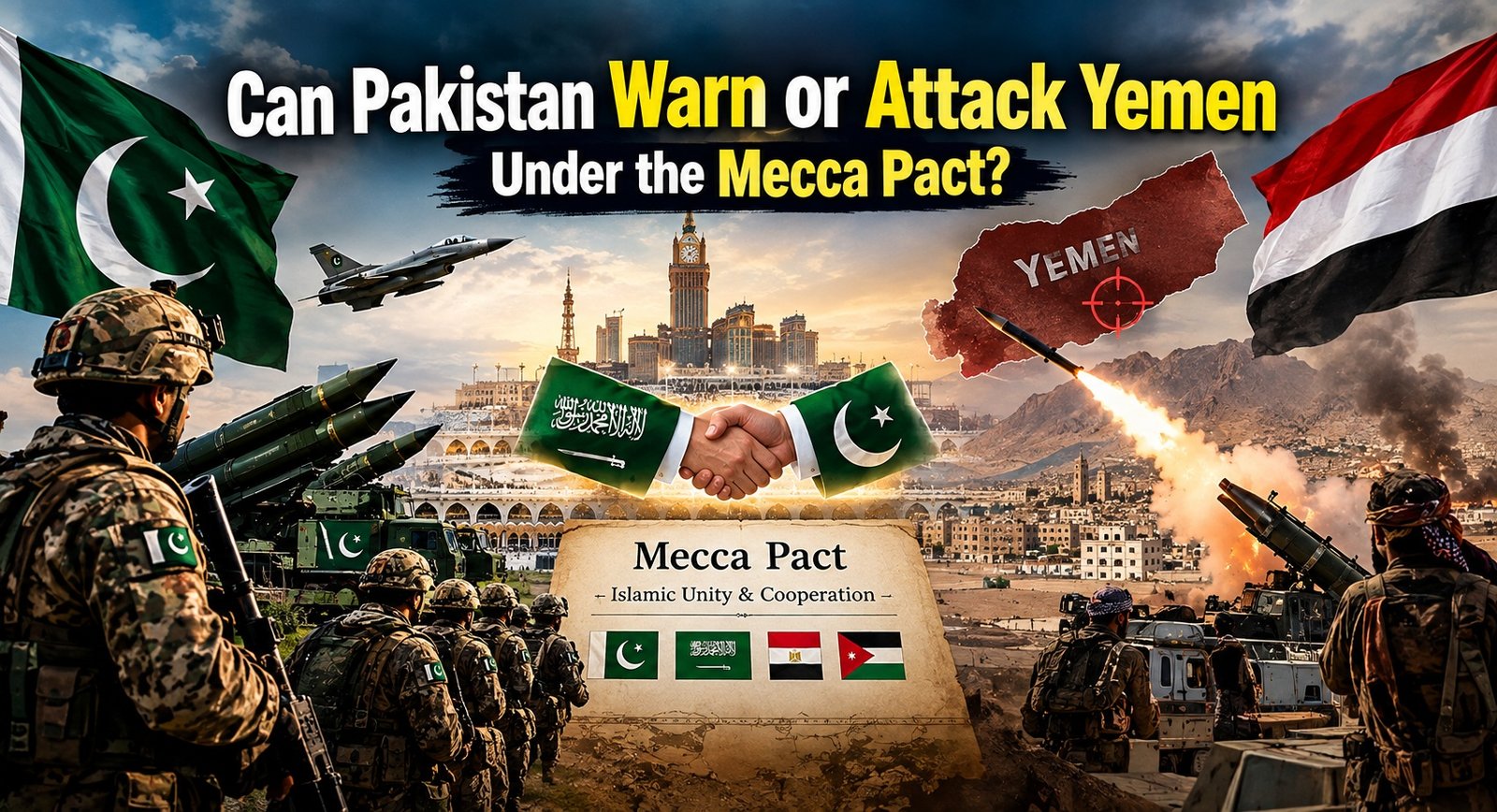
This is the question dominating regional discussion right now — and the honest answer is: legally, it’s possible in theory, but practically, it’s far from automatic. According to Wikipedia’s tracking of the 2026 Yemen offensive, Turkish media reported that Pakistan was considering airstrikes against the Houthis under the Mecca Joint Defence Agreement, and Pakistani Defense Minister Khawaja Asif warned that the Houthi attacks on Saudi Arabia “could activate the pact.” However, Pakistan subsequently clarified that no talks about actual military action were taking place, while stating the country would act “when the time comes” — language that keeps the option open without committing to anything concrete.
There are real structural reasons for that caution. Regional analysts, including those at the Arab Center in Washington DC, have pointed out that the Mecca agreement — despite the headlines — is unlikely to produce a genuine military response if an attack happens, because its full text has not been made public and it does not establish a joint command, standing forces, or a specified automatic trigger mechanism. Analysts at Israel’s INSS have made a similar point: while media reports confirm the “an attack on one is an attack on all” clause exists, the alliance’s real-world military value is limited by divergent threat perceptions among the three countries, competition for leadership in the Sunni Muslim world, and the complicated relationships both Turkey and Pakistan maintain with Iran, which backs the Houthis.
Islamabad-based defense analyst Abdullah Khan echoed this, saying that although the pact was signed during a period of heightened regional tension, it should not automatically be read as directed against Iran or any other specific actor — reinforcing that the “attack on one is an attack on all” clause is a political commitment first, and a binding military obligation second.
| Question | Short Answer |
|---|---|
| Does the Mecca Pact legally cover a Houthi attack on Saudi Arabia? | The clause’s wording is broad enough to apply, but the treaty text isn’t public and there’s no confirmed automatic trigger |
| Has Pakistan formally warned Yemen/the Houthis? | Pakistan’s Defense Minister raised the possibility of activation; no formal warning or ultimatum has been issued |
| Is Pakistan currently planning military action? | Pakistan says no active talks on military action are underway, but it “will act when the time comes” |
| Does Pakistan have a joint command structure with Saudi Arabia/Turkey to execute a response? | No — analysts note the pact lacks a joint command or standing forces |
So the realistic picture is this: Pakistan has the political and treaty basis to warn Yemen, and possibly to justify military involvement if Saudi Arabia formally invokes the pact, but as of now it has stopped short of an actual warning or military commitment, and structural gaps in the agreement mean any response would likely require fresh, specific coordination rather than an automatic deployment.
There’s also an important caveat that keeps coming up in expert analysis: Pakistan’s nuclear arsenal, while it adds significant deterrent weight to the alliance simply by association, does not extend as a formal “nuclear umbrella” over Saudi Arabia or Turkey. Analysts at Israel’s INSS were explicit on this point — the pact links three major Muslim-world powers politically and conventionally, but it stops short of the kind of extended nuclear deterrence commitment that underpins something like NATO’s relationship with non-nuclear member states. That distinction matters a great deal for how seriously outside observers should treat talk of Pakistan “activating” the pact over a Houthi attack — the political signal is real, but the hardest military guarantee in Pakistan’s toolkit isn’t automatically on the table.
What Has Pakistan Said So Far About the Houthi Attacks?
Pakistan’s official reaction has been strongly worded on the diplomatic front while staying short of a military threat. Prime Minister Shehbaz Sharif called the Houthi attacks “cowardly,” adding that such “treacherous attacks threaten the lives of innocent people as well as regional peace and security.” Separately, Pakistan reaffirmed its “unwavering solidarity” with Saudi Arabia under the joint defense pact following the attacks that wounded dozens of civilians.
This combination — strong condemnation plus a deliberately vague stance on military action — is consistent with how Pakistan has generally approached the broader regional escalation since the pact was signed. It allows Islamabad to visibly stand with Riyadh without immediately committing troops or aircraft to a conflict that is, at its core, a Saudi-Houthi civil war with Iranian backing on one side.
How Has the International Community Reacted?
Reactions beyond the region have been mixed in tone but broadly critical of the escalation. Russia’s Foreign Minister Sergey Lavrov called the Houthi attacks on Saudi Arabia “counterproductive” and said they were damaging the global economy — notable given Russia’s own complicated relationship with Western-aligned Gulf states. The wider humanitarian toll has also drawn attention: the International Organization for Migration said renewed fighting in Yemen has displaced approximately 18,500 people, warning that families are “arriving with nothing: no shelter, no food.”
The broader context matters here too. This flare-up hasn’t happened in isolation — it’s unfolding alongside the wider 2026 Iran war, in which Iran has separately struck targets inside Saudi Arabia, including reported damage to the Ras Tanura oil refinery and an attack involving Iranian drones near the US Embassy in Riyadh. That overlapping set of conflicts is a big part of why regional officials and analysts are treating the Houthi escalation as more dangerous than a routine flare-up in Yemen’s long civil war — it’s happening at the same time Saudi Arabia is already dealing with direct Iranian strikes on its own territory.
Washington’s position adds another layer worth understanding. The United States has historically condemned Houthi attacks on Saudi Arabia in strong terms going back years, and has repeatedly linked Houthi military capability to Iranian support, including accusations that Tehran has violated UN Security Council resolutions restricting arms transfers into Yemen. With the US already engaged in the parallel conflict with Iran, Washington’s reaction to this specific round of Houthi strikes is being closely watched as a signal of how far US-Gulf coordination extends beyond the Iran front itself, even though, as of the September 8 attacks, Washington had not announced any new military commitment specific to the Houthi escalation.
FAQs About the Yemen Attack on Saudi Arabia
What exactly happened in the September 2026 Yemen attack on Saudi Arabia?
Houthi forces launched ballistic missiles and drones at four Saudi cities on September 8, 2026, wounding 73 civilians and igniting fires at oil facilities — one of the largest strikes in this latest Yemen attack on Saudi Arabia escalation.
Did the Yemen attack on Saudi Arabia cause any deaths?
Official Saudi statements confirmed 73 people wounded, including women and children, from the September 8 strikes; no Saudi deaths from that specific wave were reported in coalition statements.
Why do the Houthis say they attacked Saudi Arabia?
The Houthis say the Yemen attack on Saudi Arabia was retaliation for more than 100 Saudi airstrikes inside Yemen over the prior three days, including one they blame for hitting a prison in al-Jawf.
Can Pakistan attack Yemen because of the Mecca Pact?
Pakistan’s Defense Minister said the attacks “could activate” the Mecca Pact, but Pakistan has clarified no military talks are underway regarding the Yemen attack on Saudi Arabia, saying only it will act “when the time comes.”
What does the Mecca Joint Defence Agreement actually commit Pakistan to?
It commits Pakistan, Saudi Arabia, and Turkey to treat an attack on one as an attack on all, but it has no public full text, joint command, or automatic trigger for responding to the Yemen attack on Saudi Arabia.
Is the Mecca Pact aimed at Iran or the Houthis specifically?
No. All three signatories, including Pakistan’s Foreign Minister, have stated the pact is “purely defensive” and not directed at any named country, despite speculation tied to the Yemen attack on Saudi Arabia.
How has the Yemen attack on Saudi Arabia affected oil markets?
Oil prices rose more than 1% after the September 8 strikes, with traders concerned about risks to Saudi Red Sea crude exports, which have become far more important since the Yemen attack on Saudi Arabia and the wider regional conflict began.
Conclusion
The latest Yemen attack on Saudi Arabia has done real, if contained, damage — fires at major oil facilities, a wounded civilian toll of 73 people, and a fresh jolt to oil markets already rattled by the broader Iran conflict. The Houthis frame it as retaliation for Saudi strikes inside Yemen; Saudi Arabia frames it as an unprovoked provocation it has every right to answer.
Where this leaves Pakistan is genuinely uncertain. The Mecca Joint Defence Agreement gives Islamabad a political and treaty basis to warn or even act against the Houthis if Saudi Arabia formally calls on it, and Pakistani officials have not ruled that out. But without a published treaty text, a joint command structure, or a confirmed automatic trigger, this Yemen attack on Saudi Arabia has so far produced strong words from Islamabad rather than any concrete military step — leaving the Mecca Pact’s real strength as an open question that only a future, larger crisis is likely to actually test.
For now, the situation remains fluid on every front that matters: the ground war in Yemen is still expanding into new provinces, Saudi officials have promised retaliation without yet detailing what that looks like, and Pakistan’s own position sits deliberately between solidarity and restraint. Anyone following this story should expect the next signal to come from one of three places — a formal Saudi request for Mecca Pact activation, a fresh round of Houthi strikes that raises the stakes further, or a diplomatic move toward de-escalation similar to the one that briefly held the 2022 truce together. Until one of those happens, the Yemen attack on Saudi Arabia is likely to remain a live, developing story rather than a closed chapter.
