

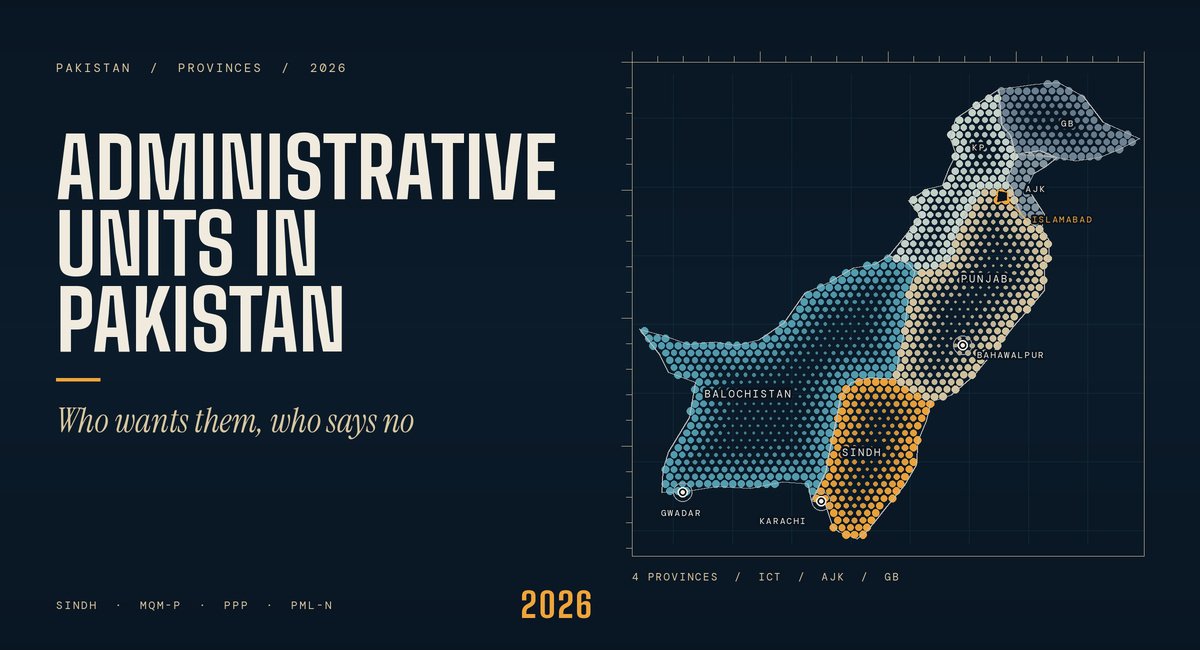
The debate over administrative units in Pakistan is the biggest constitutional argument of 2026. It began when Interior Minister Mohsin Naqvi said the governance system had failed and new units or provinces were needed. Since then the Sindh Assembly, MQM-P, the PPP, PML-N, the army’s spokesman, Sindhi lawyers and Siraiki activists have all taken sides. This guide explains who wants what, why Sindh objects, what ISPR actually said and what the Constitution requires. It separates reported facts from claims.
What are administrative units in Pakistan? (Quick answer)
Administrative units in Pakistan are proposed smaller governing areas carved out of the four existing provinces to bring services closer to people. Supporters say a country of about 250 million cannot be run through four provinces. Critics say that, depending on their design, such units could become new provinces by another name.
Key facts:
- Who started it: Naqvi, in a speech at the Pakistan Economic Summit on July 30, 2026.
- Where it stands: The government says both houses of Parliament will debate the issue in October.
- Main opponent: Sindh, where the assembly unanimously passed a resolution rejecting any division of the province.
Why does Pakistan want to create administrative units?
Supporters make three arguments.
1. Population. DG ISPR Lt Gen Ahmed Sharif Chaudhry said the population was around 70 to 80 million in 1972 and is about 250 million today. The four-province structure has not changed with it. Ahsan Iqbal, the planning minister, argued that the four provinces have become more centralised and monopolistic, hurting health and education delivery. He suggested 12 to 15 new provinces, splitting each existing province into three.
2. Governance failure. Naqvi described the current system as collapsed and unable to solve the country’s problems. He later clarified that this was a judgment on 79 years of combined performance, not on the current government.
3. Local government. Naqvi says the aim is better governance, not more governments, with powers moving to lower tiers and existing infrastructure staying in place. He also pointed to the New York mayoralty as an example of leaders who know their citizens’ problems best.
The proposals differ in scale. One reported idea would put Karachi and Gwadar under federal administration, split Balochistan in two and Punjab in three. Defence Minister Khawaja Asif floated the federal-control idea for Karachi and Gwadar. Analyst Umair Javed criticised it, arguing that it would mainly help the federal government financially without fixing municipal governance.
Who is the main character in this issue?
The central figure is Mohsin Naqvi, the interior minister and former Punjab caretaker chief minister. He raised the issue on July 30 and has not backed down. On September 5 he said he would keep supporting new provinces whether or not he stays in office, and that the people should decide after hearing the pros and cons. In Lahore he suggested that units could be named South Sindh and North Sindh, and that his plan was not meant to deprive anyone of their cultural identity.
The Diplomat notes that Naqvi is often seen as having close ties with the military establishment. That perception shapes how critics read the proposal, though the ISPR chief distanced the army from it (see below).
Timeline
| Date (2026) | Event |
|---|---|
| Jul 30 | Naqvi says the system has collapsed and calls for new units at the Pakistan Economic Summit |
| Jul 31 | DG ISPR calls it Naqvi’s personal opinion but backs an administrative reset if needed by constitutional means |
| Around Aug 1 | Sindh Bar Council condemns Naqvi’s statement as immature and non-political |
| Aug 10 | Ayaz Latif Palijo appears before the NCCIA in Karachi |
| Aug | MQM-P endorses new provinces and calls for a national dialogue |
| Sep 3 | Sindh Assembly passes its resolution against division |
| Sep 10 | Government announces an October parliamentary debate |
What do Pakistani officials think?
Federal voices are divided, but most stress process.
- Interior Minister Naqvi: in favour, with a decision to come from the people.
- Federal Parliamentary Affairs Minister Tariq Fazal Chaudhry: said Islamabad will remain a federal territory, that other parties’ feedback will go into a draft, and that the law ministry will advise whether a simple or two-thirds majority is needed.
- Defence Minister Khawaja Asif and Rana Sanaullah: said any final decision must come through consensus. Sanaullah also said the PML-N will state its position in Parliament, and that the PPP overreacted.
- Punjab’s information minister Azma Bokhari: called Naqvi’s remarks unserious about a serious issue.
- Balochistan CM Sarfraz Bugti: argued that administration, not language, should define any new provinces.
- PTI and JUI-F: said the current parliament lacks the legitimacy for such a major step.
What did ISPR say about administrative units?
The most relevant on-record ISPR remarks came at a July 31, 2026 press conference. Asked about Naqvi’s statement, the DG said it was Naqvi’s personal opinion and the military would not comment on it. He added that new administrative units are a valid question given population growth, but must reflect the will of the people. He said that if good governance requires an administrative reset, it must be done through constitutional methods, legal procedures and political representatives.
ISPR did not announce a plan, and no ISPR statement I found backs a specific map.
A manipulated video also circulated, falsely attributing a threat over new provinces to the DG. Soch Fact Check traced the clip to his July 31 conference and found the viral version altered. Check any viral “ISPR” clip against the original before sharing.
What does the MQM think about administrative units?
MQM-P is the strongest political supporter of the idea, though it is careful about wording.
- Farooq Sattar: argued that further administrative units are essential for Pakistan’s survival, development and stability, and warned of rebellions if the status quo continues.
- Mustafa Kamal: the federal minister announced street demonstrations over the Sindh government’s “systematic injustice” toward Karachi and other urban centres and renewed his demand for new provinces and devolution. He has also criticised the PPP for governing Sindh for 18 years.
- In the Sindh Assembly: Opposition Leader Ali Khursheedi said his party wants existing divisions empowered through a Provincial Finance Commission, not new provinces. MQM-P members said nobody in the house had demanded Sindh’s division. Another cited Turkey’s 80 provinces.
- The walkout: MQM-P and JI left the house because the treasury refused to add three MQM proposals to the resolution.
MQM-P is part of the federal coalition but sits in opposition in Sindh, which puts it at odds with the PPP. The Friday Times analysis argued that MQM-P members could not fully explain what powers the units would have. The PPP’s line is that a unit with its own assembly, cabinet and finance share is a province.
Why is Sindh not agreeing?
Sindh’s objections rest on history, identity and law.
1. Identity. Sindh’s resolution described the province as a historic, civilisational and constitutional entity that “is one and shall remain one.” Minister Nasir Hussain Shah said provinces are not merely administrative units, because they carry history, identity, culture and language.
2. Definitions. CM Murad Ali Shah said there is no objection to units for governance, but units with separate assemblies, chief executives and wide powers would effectively be new provinces. The PPP’s position is that administrative reform and dividing Sindh are separate matters.
3. The Karachi question. Sindh fears Karachi’s revenue and control would be split off, as the federal-control proposals suggest. Industries Minister Jam Ikramullah Dharejo said Karachi is an inseparable part of the province.
4. Repeated resolutions. The assembly has passed several against division. One report lists 1948, 2000, 2014, 2019 and 2026, while another cites 2012, 2014 and 2019. Dates vary by source, but the pattern is consistent.
What is the PPP’s role in the Sindh Assembly?
The PPP holds 117 of 168 seats, so it leads the province. Its Sindh president Nisar Khuhro moved the adjournment motion, and 85 members spoke over the four-day debate. The resolution rejected any plan to divide Sindh, alter its limits, create a province from its territory or place any part under a separate federal arrangement. MQM-P and JI walked out before it was tabled, and no PTI lawmakers were present.
Senior minister Sharjeel Memon said province creation is a constitutional matter, not something to decide through referendums, street protests or TV talk shows. Murad said any change to Sindh’s boundaries without its elected assembly’s consent is unacceptable and unconstitutional.
What did Sindhi lawyers say about Mohsin Naqvi’s statement?
The Sindh Bar Council issued a statement unequivocally condemning what it called the immature and non-political statement of the interior minister. I could see only the opening line, not the full text. Individual lawyers also urged bar bodies to pass resolutions against it.
Other bar bodies split:
- The Supreme Court Bar Association backed Naqvi’s proposal, citing governance benefits.
- The Pakistan Bar Council insisted any such move must follow the parliamentary process with national consensus.
- Lahore’s lawyers called the remarks unconstitutional.
- PBC member Barrister Salahuddin Ahmed said Article 239 requires two-thirds majorities in the provincial assembly and both houses, so backers might try to amend the article itself.
What did Ayaz Latif Palijo say, and what happened at the NCCIA?
Ayaz Latif Palijo, president of Qaumi Awami Tehreek and a Supreme Court advocate, opposes any division of Sindh. He told The News, using the image of a mother, that no child would want their mother divided in two and that Sindhis want one Sindh.
On August 10, 2026, he appeared before the NCCIA at its Gulistan-e-Johar office in Karachi in response to a notice over an alleged anti-state narrative. He recorded his statement over his public opposition to a proposal to separate Karachi from Sindh and told supporters outside that no legal justification had been given and that any attempt to divide Sindh will never succeed. In written replies to 19 questions, he said the inquiry was an attempt to harass and silence him, and that political criticism cannot be labelled anti-state activity.
The summons drew a fast reaction. Court proceedings were suspended in Hyderabad, Sukkur, Larkana, Tando Allahyar and Mirpurkhas, and the Sindh Bar Council and bar associations passed resolutions of solidarity. Prominent lawyers called the summons illegal and politically motivated. On August 24, police detained more than 25 Awami Tehreek activists at a rally in Mithi against the plan to “divide” Sindh.
Why do Sindhi groups oppose administrative units, and is it a conspiracy?
Sindhi nationalist groups demanded Naqvi’s resignation, and bar bodies, the PPP and the chief minister all rejected the proposal. Their concern is that “administrative units” is a step toward splitting Sindh, and Karachi in particular. Palijo also argued that state institutions are being used to suppress voices against the proposal.
Is it a conspiracy? Here is what can and cannot be said.
- What critics allege: that the push is part of an establishment plan. A Friday Times column said President Zardari had apparently taken a tough stand against it as part of such a plan. That is opinion, not documented fact.
- What officials say: Naqvi says the aim is governance, not identity. ISPR called his remarks personal.
- What the public record shows: a proposal, a set of competing statements and an October debate. I found no public evidence of a secret plan, and no evidence ruling one out. Treat “conspiracy” as an allegation until evidence appears.
The safest reading is that this is a real constitutional dispute with a trust problem. Sindh’s suspicion is fed by the federal-control ideas for Karachi and by the NCCIA summons.
What is the PPP’s role in the National Assembly and the federal government?
The PPP is a key coalition partner of the PML-N but is now openly unhappy. Its Secretary General Nayyar Hussain Bukhari said only Parliament can create provinces, not executive orders, and that the issue would go to the PPP’s Central Executive Committee. He also said a constitutional amendment would need two-thirds in both houses, that the prime minister must state his position, and that the federal cabinet should first consider it. Notably, the PML-N-led government has that majority in the National Assembly only with PPP support, which gives the PPP real leverage.
A PPP meeting urged the prime minister to take notice of ministers’ remarks and stop them. The party is also upset over the AJK elections, per Geo. It’s worth noting that the PPP has itself backed a Siraiki province in Punjab, which the PML-N has used to argue the PPP is inconsistent.
What is the PML-N’s role?
The PML-N leads the federal government. It holds 132 of 336 National Assembly seats, and Shehbaz Sharif is prime minister. Its position is unclear.
- No formal stance yet: Neither Nawaz Sharif nor Punjab CM Maryam Nawaz has publicly stated a clear position.
- Divided signals: Hamza Shehbaz said good local government would remove the need for new provinces, Ahsan Iqbal proposed 12 to 15, and Khawaja Asif backed units on administrative rather than ethnic grounds.
- Reported reasons for the silence: journalist Hamid Mir claimed Maryam Nawaz opposes new provinces in Punjab and Shehbaz Sharif is silent because of it. That is one commentator’s claim.
- History: In 2019 the PML-N tabled a bill for Bahawalpur and South Punjab provinces. Geo’s opinion piece notes the party’s present caution now that Maryam holds Lahore.
What do the Siraikis think, and what about Bahawalpur?
The Siraiki movement predates the 2026 debate. The Saraiki language movement began in the late 1960s and later became a movement for a separate province. South Punjab generally means the Multan, Bahawalpur and Dera Ghazi Khan divisions, about 52 percent of Punjab’s area and nearly 40 percent of its population.
Bahawalpur has its own claim. Its Nawab signed an accession agreement on October 5, 1947, accepted on October 9, making it the first state to accede to Pakistan. After the One Unit scheme, Bahawalpur got divisional status in Punjab in 1970. A parliamentary committee recommended a Bahawalpur South Punjab province in January 2013. Locals speak Riasti, which also complicates a single Siraiki identity.
Recent political history shows shifting support:
- In 2012, the National Assembly and Punjab Assembly passed resolutions for a new province in Punjab, backed by the PPP and PML-N.
- In 2022, the Senate accepted a South Punjab bill.
- In 2026, a PPP member demanded Saraikistan in the Punjab Assembly and a PPP senator repeated the South Punjab demand in the Senate.
- This year, ex-minister Muhammad Ali Durrani said an amendment restoring Bahawalpur and creating Hazara would come before Parliament, and Abdul Aleem Khan backed Hazara, South Punjab and Bahawalpur.
Khawaja Asif argued that the PPP supports a Saraiki province but cries “Sindhudesh” when multiple units are proposed. The PPP would say Sindh’s case differs because its resolution is about its own territory.
What does the law say, and what happens next?
Under Article 239, changing a province’s boundaries needs two-thirds majorities in Parliament and in the assembly of any province being divided. A referendum is possible under Article 48(6), but a referendum would not itself create a province, since boundary changes must follow the constitutional process.
| Party / group | Stance | Key point |
|---|---|---|
| Interior Minister Naqvi | For | People should decide |
| ISPR | Neutral, pro-governance | Personal opinion of Naqvi |
| MQM-P | For units | Not new provinces, existing divisions empowered |
| PPP | Against division | Only Parliament can decide |
| PML-N | Undeclared | Position to be stated in Parliament |
| PTI, JUI-F | Critical | Question parliament’s legitimacy |
Quick Q&A
Who proposed new administrative units? Interior Minister Mohsin Naqvi, on July 30, 2026.
Has any bill been tabled? Rana Sanaullah said neither a bill nor a resolution had been submitted to parliament at that point.
When will Parliament discuss it? In October, per the parliamentary affairs minister.
Is the army behind it? ISPR called it Naqvi’s personal opinion.
Does MQM want to divide Sindh? MQM-P says no; it wants administrative units and devolution.
Frequently asked questions
Why does Pakistan want new administrative units?
Supporters point to population growth and weak service delivery. They argue smaller units would improve governance, and that four provinces cannot manage 250 million people.
Why is Sindh against administrative units in Pakistan?
Sindh sees units, especially around Karachi, as a route to dividing the province. The PPP also argues that units with assemblies and cabinets would amount to new provinces.
What is the MQM’s opinion on administrative units in Pakistan?
MQM-P supports new units and devolution. It says it does not want Sindh divided and instead wants existing divisions given financial and administrative powers.
What did ISPR say about administrative units?
On July 31, the DG called Naqvi’s remarks personal, said the military would not comment, and said any reset must follow constitutional methods and the people’s will.
What is the PPP’s position in Parliament?
It says only Parliament can create provinces, needs a two-thirds vote, and wants the prime minister to state his stance. It remains a coalition partner.
Who first joined Pakistan among the princely states?
Bahawalpur is documented as the first state to accede, on October 5, 1947, with acceptance on October 9.
How can I follow the debate on administrative units in Pakistan?
Follow Dawn, Express Tribune, Geo and The News, and the October parliamentary sessions. Verify viral clips before sharing.
Conclusion
Administrative units in Pakistan are a real governance question wrapped in an identity fight. Supporters cite population and failing services, and Sindh sees a threat to its unity. The law requires wide consensus, and the PPP’s coalition leverage matters. The next test is the October parliamentary debate, where the PML-N must finally state its position. Until then, administrative units in Pakistan remain a proposal, not a plan, so check each claim against a primary source.
Sources
- Dawn, Sindh Assembly resolution: https://www.dawn.com/news/2027321
- Dawn, opposition debate: https://www.dawn.com/news/2027024
- Express Tribune, Parliament showdown looms: https://tribune.com.pk/story/2628653/parliament-showdown-looms-over-new-units
- ARY News, DG ISPR statement: https://arynews.tv/dg-ispr-statement-on-new-provinces
- The News, ISPR DG: https://www.thenews.pk/print/1429541-new-administrative-units-needed-but-with-people-s-will-ispr-dg
- Friday Times, Palijo and NCCIA: https://www.thefridaytimes.com/11-Aug-2026/palijo-rejects-sindh-division-courts-shut-protest
- Express Tribune, Palijo’s replies: https://tribune.com.pk/story/2624298/ayaz-palijo-submits-written-replies-to-nccia-over-inquiry
- Dawn, lawyers’ bodies: https://www.dawn.com/news/2021389/lawyers-differ-on-approach-to-new-provinces
- Dawn, PML-N position: https://www.dawn.com/news/2029559/pml-n-to-state-its-position-on-provinces-in-parliament
- Wikipedia, Bahawalpur (princely state): https://en.wikipedia.org/wiki/Bahawalpur_(princely_state)
Editorial note: this is analysis of public reporting, not legal advice. The Sindh Bar Council statement was only partly visible, and a Friday Times column is opinion.
